

-
Intershop pipelines differ from intrashops by the presence of long rectilinear sections with a significantly lower specific consumption of pipeline parts, fittings and fasteners.
Installation of intershop pipelines is made from finished sections up to 40 m long, centrally manufactured in pipe harvesting shops or on landfills.
The length of the finished sections depends on the diameter of the pipeline, the availability of lifting and transport mechanisms, local working conditions and transportation conditions.
According to the method of laying intershop pipelines are divided into above-ground and underground
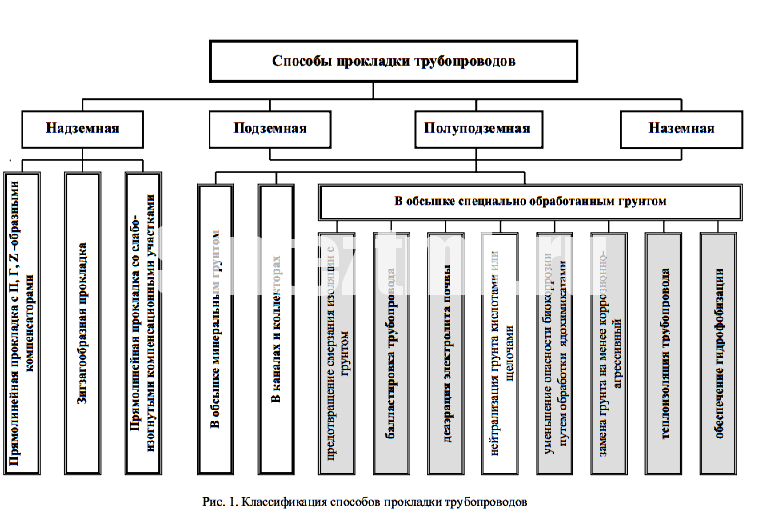
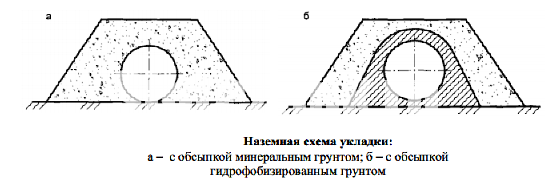
Installation of overground pipelines
At the intersection of sections of the route, laid down by fissure or permafrost subsidence soils, to reduce the thermal effect on the soil, the pipeline is laid on a heat-insulating layer. The method of construction of above-ground pipelines depends on its design solutions.
During the construction of an undeep pipeline, if necessary, a backing, slack lining are built. The pipeline is welded into a thread and laid on a prepared base. Guide and fixed stops and supports, depending on their design, are mounted before or after laying the pipeline on the base. Insulation works are carried out before laying the pipeline on the base. The base is more often constructed in a bulk way and less often hydromassive.
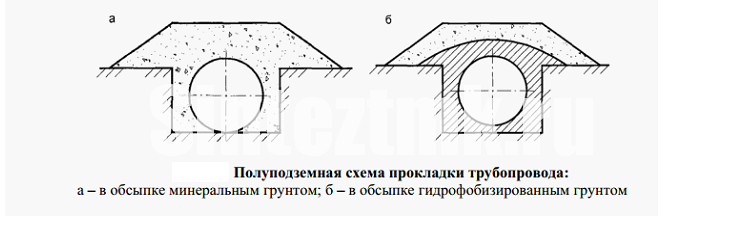
During the construction of a semi-deep pipeline, the trench of the required depth is first torn off. After that, the pipeline is welded into the thread, isolated and laid in a trench and, if necessary, collapsed.
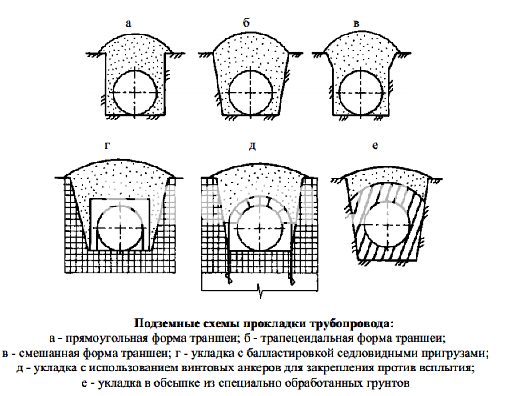
Installation of underground pipelines
It is used for gas pipelines and for product pipelines pumping light and dark oil products with a solidification temperature below 0 ° C.
Channelless underground pipelines for highly viscous or paraffinous petroleum products frozen above 0° C is allowed with mandatory emptying of pipes at the end of pumping or when replacing a viscous liquid with a low-viscosity liquid that does not freeze during pumping stops.
Pipes are laid at the bottom of the trench, planned in accordance with the design marks. With solid soils under the pipe being laid, a layer of sand of 10-20 cm is made. The outer surface of the pipe is covered with anticorrosion insulation. A trench with a laid pipe is filled with excavated soil.
Soil protects pipelines from cooling, being a kind of thermal insulation. Thermal losses of underground pipelines are much less than ground-based (by 3-4 times).
The depth of laying pipelines in the ground is in the range from 0.8 to 1.8 liters and in rare cases more than 1.8 liters. It is determined by a number of factors, for example, fluctuations in soil temperature, the magnitude of capital costs for laying pipelines, the resulting stresses in pipelines, etc.
The laying of pipelines for oil products and gas in the zone of soil freezing is technically possible, and from the economic side is profitable and expedient, since it reduces the amount of excavation work and accelerates construction; in addition, in operation, it is easier to detect and eliminate accidents, as well as repair work.
Pipelines for the transportation of watered petroleum products should be laid below the depth of freezing of the soil in order to avoid freezing of water in moments of inactivity of the pipeline, if it is not released from the oil product.
The depth of laying should be assigned on the basis of an analysis of the conditions of technological and thermal operation of pipelines, taking into account technical and economic considerations. For pipelines transporting light oil products, low-viscosity and paraffin oils, the depth of the deposit, counting from the surface of the earth to the top of the pipe, it is recommended to appoint: for the European part of the USSR, the middle and southern part of Kazakhstan and the Central Asian republics – 0.8; for the Urals, Siberia and Northern Kazakhstan – 0.9-1.2 g.
For pipelines transporting viscous, paraffin and fast-fixing oils and petroleum products, as well as oil requiring heating, the depth of embedding should be assigned differently, depending on the physicochemical properties (colding temperature, viscosity, paraffin precipitation conditions, etc.), the temperature regime of the pipeline and operating costs.

Installation of intershop pipelines is carried out in accordance with the following regulatory documents:
SNIP 3.05.05-84 Technological equipment and technological pipelines
VSN 362-87 Manufacturing, installation and testing of technological pipelines on Ru up to 10 MPa
SP 61.13330.2012. Thermal insulation of equipment and pipelines