

-
Installation of foundation bolts is one of the concluding actions in terms of installation of equipment. The equipment completeness given in the technical specification and design documentation must include foundation bolts equipped with embedded parts. During installation, the equipment is installed on the foundation and fixed from moving in any of the planes with the help of special bolts, the choice of which depends on the type of load transferred to it and the specifics of the sealing.
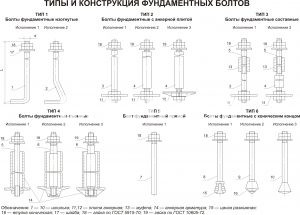
By design, foundation bolts can be carried out tightly laid in the foundation, mortgaged in special sockets or wells, the need for which appears during the installation of auxiliary equipment, removable, involving the use of anchor plates, deaf when they are mounted by a conductor serving to set the desired direction, after which they are poured with concrete mortar at the construction stage of the foundation.
The material for the manufacture of the conductor device is steel. This type of foundation bolts is necessary for the installation of large equipment and components subject to constant dynamic loads.
If necessary, adjust the installation of equipment in height, foundation bolts are also used.

In order to achieve the most rigid fixation of the unit on the base, a conductor device is first manufactured and attached to the foundation, on which foundation bolts are then installed. Conductor devices are a system of horizontal elements, racks and connections. The place of fastening is filled with concrete, after its solidification is cleaned. The conductor devices can then be partially dismantled. The permissible deviation on the plane for bolts does not exceed 10 mm. With this method of installation, the ratio of spent metal to the weight of bolts is about 2.5. For not very responsible auxiliary equipment, wooden conductors are sometimes used, which can be mounted directly to the formwork.
With other methods, it is impossible to achieve such accuracy in installing foundation bolts, and deviations can be quite large both in the horizontal and vertical planes. Lower costs with a sufficiently high accuracy of the installation is provided with the plase-block method, preferable if it is necessary to use a large number of bolts. On the plazas, which are special wooden stands, blocks are assembled, where groups of bolts are welded to the support beams, between which connections are located. Such a farm provides good rigidity, the accuracy of installing bolts up to 3 mm and ease of installation with economical consumption of metal. Portals or other lifts are used to lay these blocks. With this method, in addition to saving materials, you can significantly reduce the installation time of foundation bolts, making all the necessary blocks on a separate site at once, and then load them into the machine, deliver them to the place of the foundation device and lay with the help of a lift.
In the manufacture of wooden crates for blocks, organic-based adhesives are used, which leads to a decrease in the strength of the connection over time or when heated. This reduces the popularity of using the block method, leaving the primacy for pouring concrete. The limitation here is the use of only shrinkless solutions for minting bolts.
If heavy equipment operating with cyclic dynamic load is installed, additional strengthening of the coupling with the foundation may be necessary. In this case, anchor bolts installed through technological holes at the base of the unit are used.
For often moved to a new place, conical foundation bolts with tsangs are used. Conical bolts without tsang do not impose special requirements for the accuracy of the holes and are easier to manufacture. The disadvantage of such bolts is the need to wait at least a week after sealing before using the anchor mount.
Convenient for additional fastening of the unit, especially installed away from other equipment, self-activating bolts. In the foundation drill holes where these bolts are inserted. They can be used immediately after installation. The advantages of self-activating bolts are a decrease in metal consumption, savings on the manufacture of conductor devices, the possibility of reducing the thickness of the foundation, if it is not regulated by the characteristics of the equipment, and speed up the installation process.
Sometimes, after installing the equipment through the technological holes in the equipment base, a hole in the base is drilled and a tsang anchor bolt is used.
To fasten heavy units operating in heavy dynamic mode, with limited access for service, deaf or anchor bolts should be used, Hilti anchor bolts are often used.
Increased costs for their installation are paid off by high operational reliability, and for fastening small, separate equipment, technological metal structures, it is rational to use self-anchoring bolts.

Normative documents used to work with foundation bolts for installation of technological equipment:
Guide to fastening technological equipment with foundation bolts (CH 471-75)
GOST 24379.0-2012.Basic bolts. General technical specifications.