

-
Transportation of columns is necessary in the construction of buildings, columns are supported by beams, spans and other building elements. Columns are characterized by high strength and are able to withstand significant loads during compression and bending. These elements are made of concrete, reinforced with metal rods.
The length of the columns may vary depending on the purpose. If one-storey houses are being built, a column is used, the length of which is equal to the height of the floor, because it is located vertically.
In multi-storey or industrial construction, the length of the columns must support the ceilings at a height of several floors.
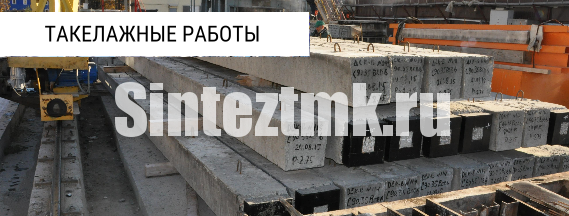
Pillar rigging
The columns can reach sixteen meters in length and weigh up to 20 tons. Their feature is the high strength in the longitudinal direction and the risk of destruction under transverse load. This determines the specifics of rigging work when moving columns.
When delivering columns from the manufacturer to the installation site, loading into transport, transportation, unloading and installation will be required. To work, you will need a crane of appropriate power and slings or ropes. The design of the columns provides for the presence of sling holes. Some manufacturers perform mounting loops instead of holes, which is allowed by standards.
Depending on the size of the columns, flexible or lightweight slings with one or more branches are used to lift them. Flexible are used for small sizes of columns, consist of segments of steel rope with a diameter of 12 to 30 mm and has the shape of a loop. At the ends of lightweight slings hooks, loops on kows, carbines are installed.
The main requirements for slinging columns are reliable and convenient capture, lifting and installation in a given position, easy arrangement. It is convenient to use semi-automatic devices when lifting columns, which allow you to perform decomposition from the cabin of the lifting device or from the ground.
Convenient to use for rigging special grippers for columns. Unlike traverses, the attachment of which occurs through pins inserted into the sling holes to perform the alignment, you do not need to climb the column and disconnect the mount. They can be performed in the form of semi-automatic and strap grips and are used in installation.
Capture slings are cheaper and have a simpler design, but are used mainly for small columns.
U-shaped semi-automatic grippers are equipped with an electric motor, which, after installing the column in a vertical position, turns the screw moving the locking finger. This allows the capture to be disconnected from the ground or from the crane cabin. Such a seizure is designed to lift cargoes weighing up to 50 tons.
To lift especially heavy columns of long length can be used to move the lower edge on the trolley or with the help of a rotary shoe to make a turn around the base, holding the second end on the lift arrow. This may be necessary if there is no possibility of using a crane of the desired load capacity.
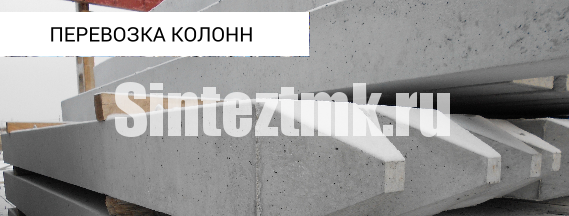
Transportation of columns
Transportation of columns on the one hand requires a careful attitude to prevent their damage, on the other – to ensure the safety of traffic. For these purposes, you will need a special transport equipped with an on-board semi-trailer designed to carry such a weight, or ladders, or stoves.
It is necessary to arrange columns during transportation horizontally, their transportation by stack is allowed. In the first row, the columns are laid flat on the platform of the car, and the following rows are laid on wooden gaskets, the place of installation of which is indicated by the manufacturer and most often coincides with the location of the sling holes. The stacked LBI should be secured with a linkage wire.
In winter, when transporting columns can be covered with ice crust or snow, which makes their surface slippery and can lead to shift during transportation. To avoid moving the columns, rubber tape is attached to the gaskets.
The number of rows is limited by the carrying capacity of the transport and the design of the VBI. For ordinary columns with a rectangular cross-section, the number of rows should not exceed, for extreme two-branched columns, a maximum of three are allowed, for medium ones, two. Two-branch columns can be transported, leaning edge on the platform, if their stability is ensured.
When choosing a car, you need to take into account the size and weight of the columns transported. Transportation of such long structures can cause difficulties when driving, especially since most often most of the way passes through the city, where there is heavy traffic, everywhere above the road are advertising banners, electrical wires.
The length of the reinforced concrete column reaches 15 meters. But in some cases, longer non-standard columns may be needed for construction. To transport such structures, cars with a long trailer or road trains are necessary. The route of transportation of such products is carefully calculated and coordinated in road services and traffic police. Special transport escorts are used to accompany road trains with a length of more than 20 meters.